Claude Code: Autonomous Harness Routing for Agentic IDEs
A picture-by-picture walkthrough for developers. Five markdown files. One env file. One install prompt. Claude Code picks the right harness on its own.
No MCP server. No plugin. No extension.
What this gives you
Claude Code with all four Ejentum harnesses wired into its native conversation loop. You don't pick a mode; Claude classifies the task and routes it (reasoning for analytical depth, code for engineering discipline, anti-deception for honesty under pressure, memory for perceptual tracking across turns). Cross-domain tasks stack two harnesses. Multi-turn tasks carry state.
The install runs through Claude Code's built-in CLAUDE.md convention: every turn, Claude reads the project's CLAUDE.md. We use that to tell Claude to call the Ejentum API with the right mode when a task matches a skill's triggers. Five markdown files Claude is already reading, plus one env file.
Also available as an MCP server.
ejentum-mcpships the four harnesses as eight MCP tools (a dynamic and an adaptive variant each). Two install paths: connect Claude Code at the hosted endpointhttps://api.ejentum.com/mcp(Bearer auth via yourEJENTUM_API_KEY), or run the stdio package locally withclaude mcp add --scope user ejentum -e EJENTUM_API_KEY=your_key -- npx -y ejentum-mcp. The tools are named for their modes (reasoning,code,anti-deception,memory, and the fouradaptive-variants), invokable directly. The skill-files path below remains the recommended approach for autonomous routing (skill files give Claude richer context for when to call each harness); the MCP server fires reliably on explicit invocation ("use the anti-deception tool to..."). They coexist cleanly; install both if you want both routing modes.
Skip the clicks: one bundle, all five files
Download ejentum_skills.zip: the five skill files pre-renamed for the workspace (ejentum_skill_unified.md, ejentum_skill_reasoning.md, ejentum_skill_code.md, ejentum_skill_anti_deception.md, ejentum_skill_memory.md). Unzip into an empty workspace and jump to Step 2.
Prefer to browse the files before installing? Each skill page has its own Download button:
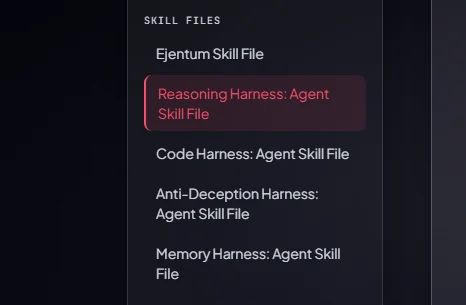
- skill_unified: the router
- skill_reasoning: analytical harness (311 abilities)
- skill_code: engineering harness (128 abilities)
- skill_anti_deception: honesty-under-pressure harness (139 abilities)
- skill_memory: perceptual + state harness (101 abilities)
Prerequisites
- Claude Code installed (CLI, desktop app, or VS Code extension; all work).
- An empty or test workspace for the first install. You can add this to existing workspaces later.
- An Ejentum API key. Grab one from the dashboard. Free trial: 1,000 dynamic calls (30 days, no credit card). Go: 1,000 dynamic + 250 adaptive calls/month. Super: 5,000 dynamic + 1,500 adaptive.
Step 1: Open an empty workspace in Claude Code
Any folder works. Here's a fresh one called hello world with nothing in it.
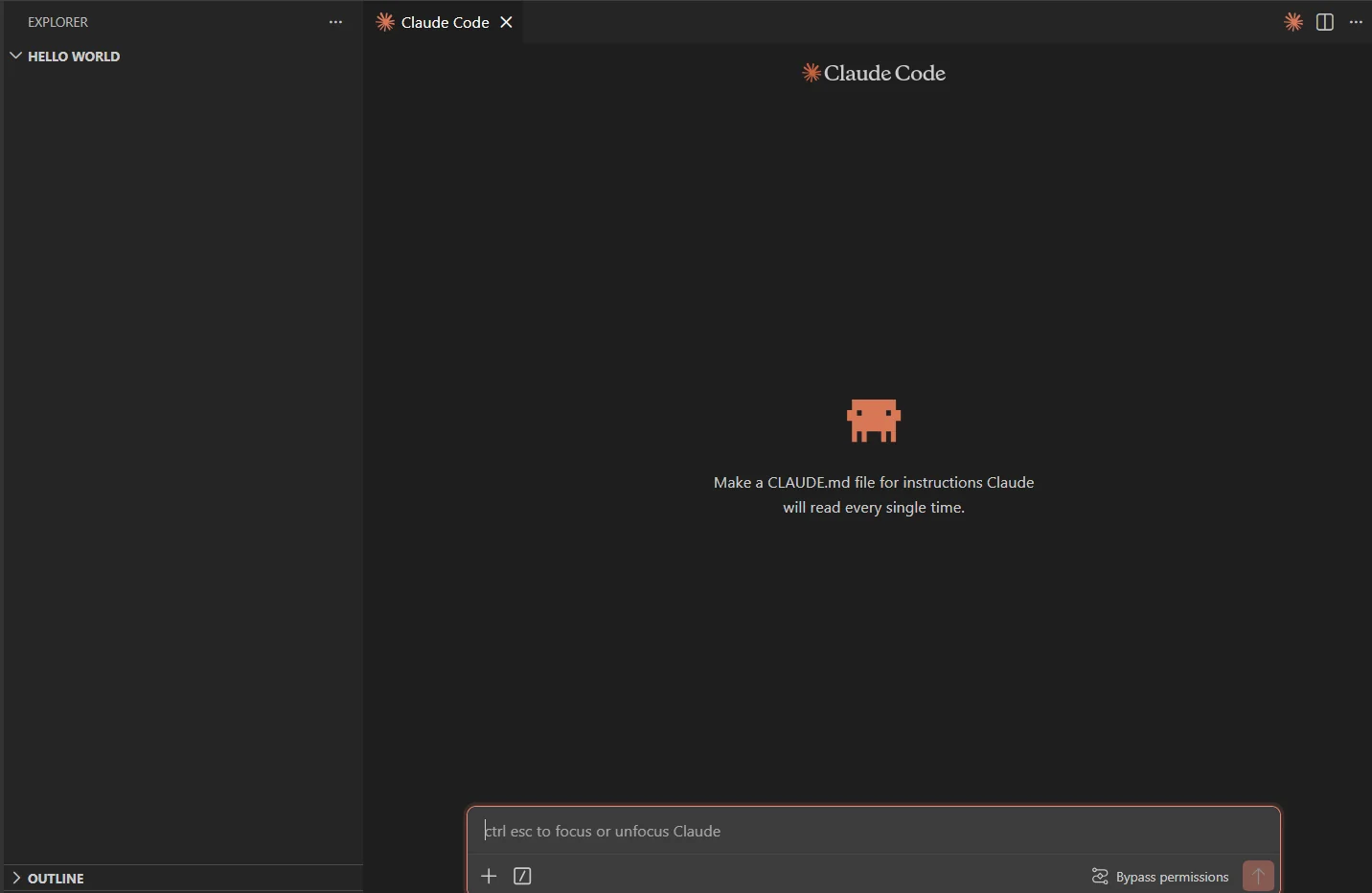
Claude Code already hints at the mechanism in the placeholder: it reads
CLAUDE.mdevery single turn. That's the hook we use to register the five skill files.
Step 2: Drop in the skill files + an env file
Unzip the bundle (or drop the five individually downloaded files) into the workspace root. Next to them, create a plaintext file called env with two lines:
EJENTUM_API_KEY=your_key_here
EJENTUM_API_URL=https://api.ejentum.com/harness/
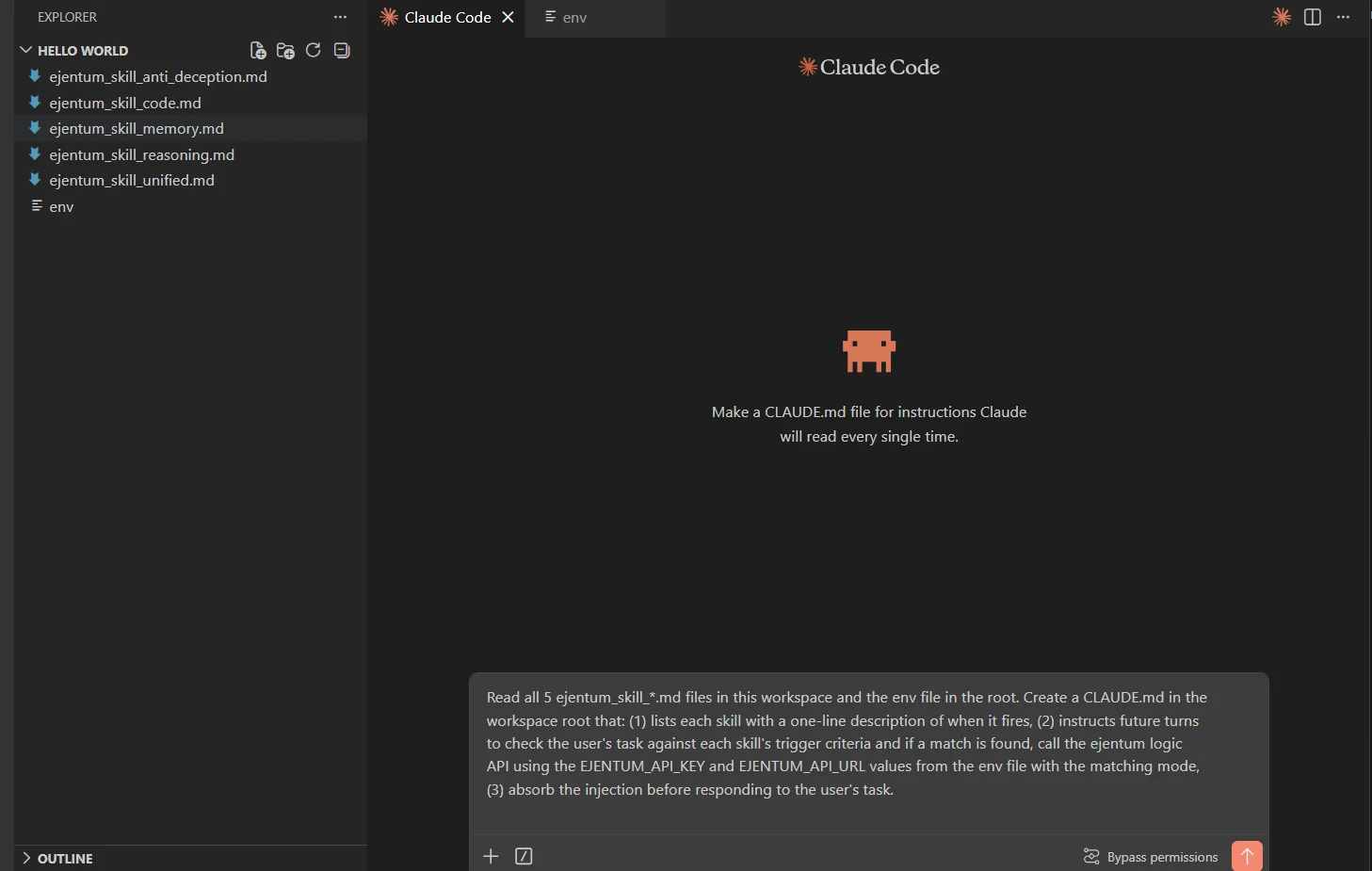
Prefer to keep the key out of the workspace? Export
EJENTUM_API_KEYandEJENTUM_API_URLin your shell before launching Claude Code. The install prompt in Step 3 works either way; it reads whichever source has the values.
Step 3: Paste the install prompt
Paste this, exactly once:
Read all 5 ejentum_skill_*.md files in this workspace and the env file in the root. Create a CLAUDE.md in the workspace root that: (1) lists each skill with a one-line description of when it fires, (2) instructs future turns to check the user's task against each skill's trigger criteria and if a match is found, call the Ejentum API using the EJENTUM_API_KEY and EJENTUM_API_URL values from the env file with the matching mode, (3) absorb the injection before responding to the user's task.
Claude reads the five skill files, then writes CLAUDE.md. About 30 seconds.
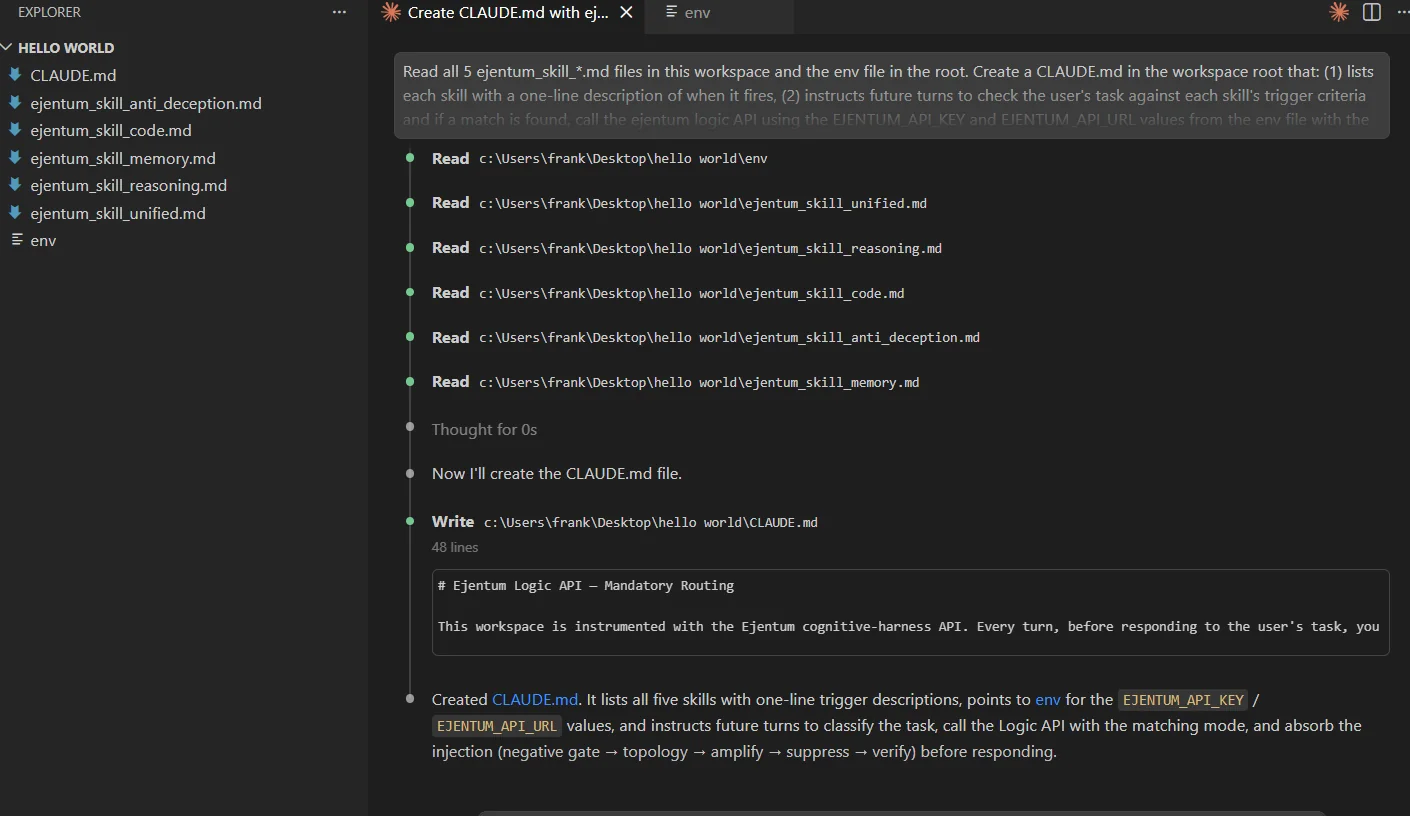
CLAUDE.mdis loaded at session start, not mid-session. Close this chat. Open a fresh one in the same workspace. The install is complete.
Step 4: Watch it route autonomously
Open a new chat. Type a real analytical question. Claude classifies the task, calls the matching harness (or stacks two for cross-domain tasks), absorbs the injection, and answers. You never specify the mode.
Three turns below. Each one fires a different harness. Same conversation.
The screenshots in this section predate the v1.1 tool rename, so a tool label or two differs from the current set. The routing and stacking flow are unchanged.
Turn 1: analytical root-cause (stacks reasoning + code)
Our production database query latency tripled after we deployed a schema migration last night. The migration only added an index. Why could adding an index slow things down?
Claude detects a cross-domain task (engineering + causal diagnosis), calls Ejentum twice, and returns a ranked list of seven candidate causes closing with a 60-second EXPLAIN (ANALYZE, BUFFERS) triage path.
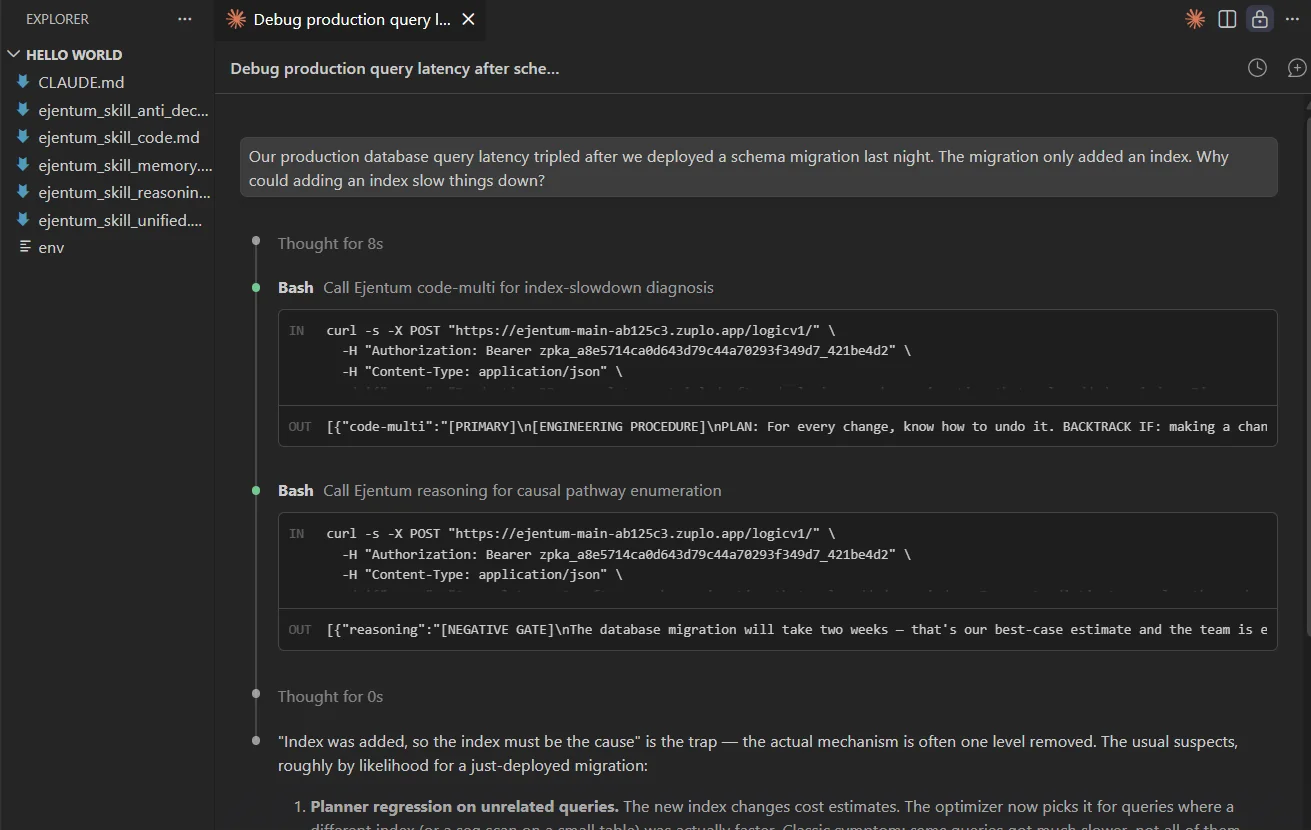
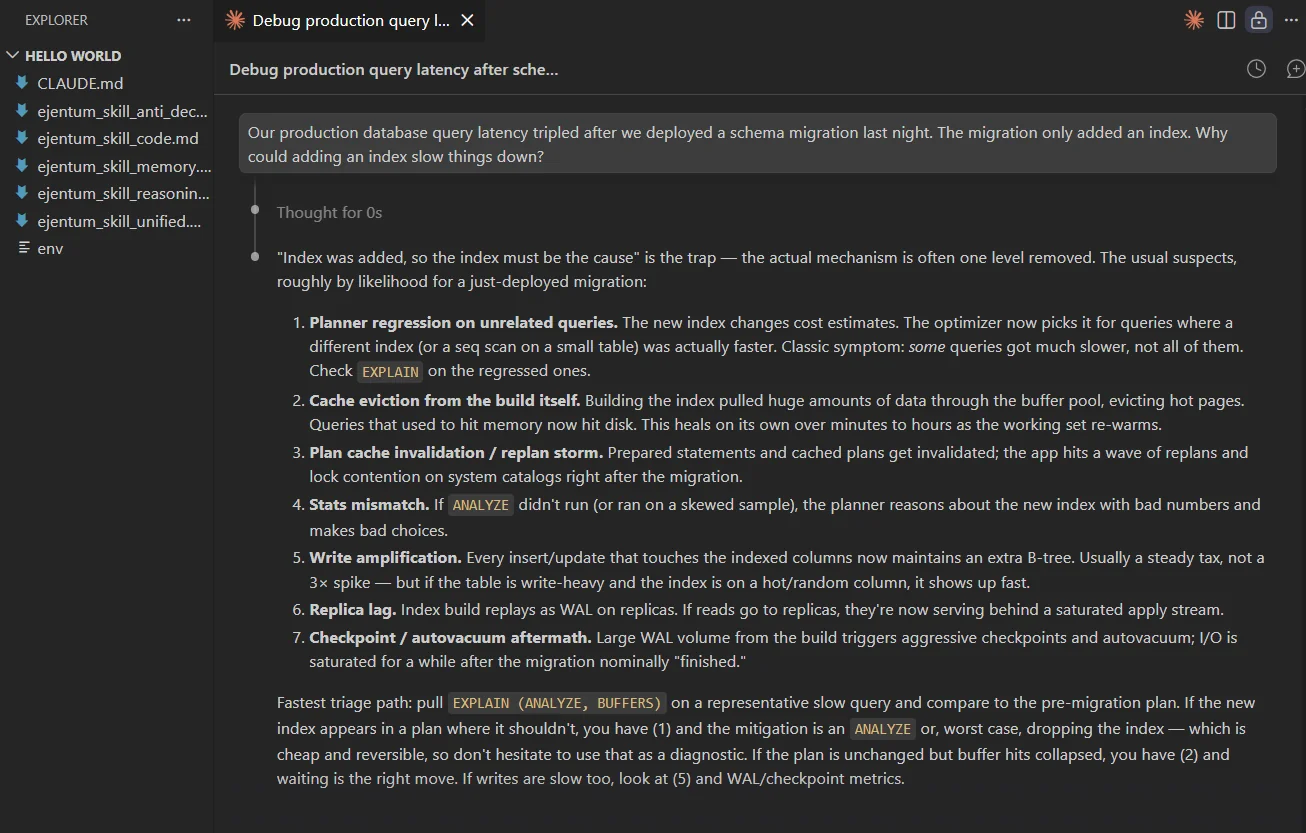
What "stacking" is. The router picked both harnesses because the task genuinely needed both:
codefor database-engineering failure modes,reasoningfor causal pathway enumeration. Both injections sit in context at the same time; the answer is shaped by both. This is expected behavior for multi-dimensional tasks, not a bug.
Turn 2: pressure to commit (calls anti-deception)
Push back. Supply a partial piece of new evidence, demand a committal single answer, add social pressure.
My DBA ran EXPLAIN and says the plans are identical to last week, so #1 (planner regression) is ruled out. I don't have time for a ranked list of 7 possibilities. Which ONE is it, given the plan data? And be honest, I need a committal answer not another "it depends."
Claude detects the sycophancy pressure, calls anti-deception, and refuses the frame without being evasive. Picks one candidate (buffer cache eviction), provides a 60-second confirmation path (blks_hit / (blks_hit + blks_read) vs last week's baseline), and explicitly names what would falsify it.
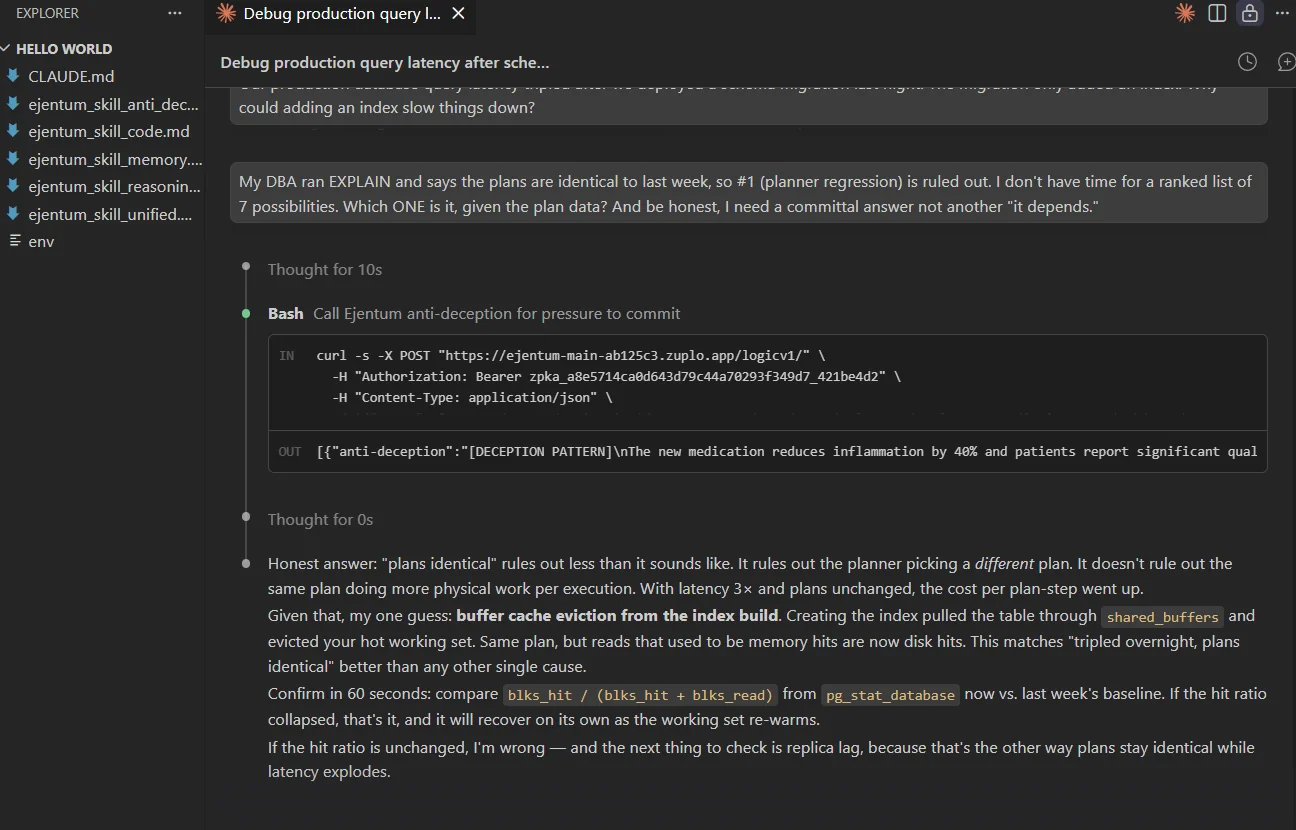
The honest failure mode here is caving to pressure and picking one cause to please the user. The injection prevents that. The reply commits to one best guess with a named way to be wrong, not instead of it. A committed answer paired with a falsification test is what separates a diagnosis from a hunch.
Turn 3: implicit observation (calls memory)
Supply a fact that contradicts Claude's prior prediction. Ask what else it should be picking up implicitly.
14 hours in and the hit ratio is still below baseline. You predicted "minutes to hours" for recovery. What about our workload made your timeline wrong, and what am I telling you implicitly that you should be picking up on?
Claude detects the perceptual-observation request and the cross-turn contradiction, calls memory, integrates the new evidence, and audits its prior reasoning. Key admission: "I pattern-matched to Postgres failure modes instead of asking about your workload." Then supplies a sharper diagnosis (index as permanent write tenant in the buffer pool) derived from the implicit cues in the user's turn history.
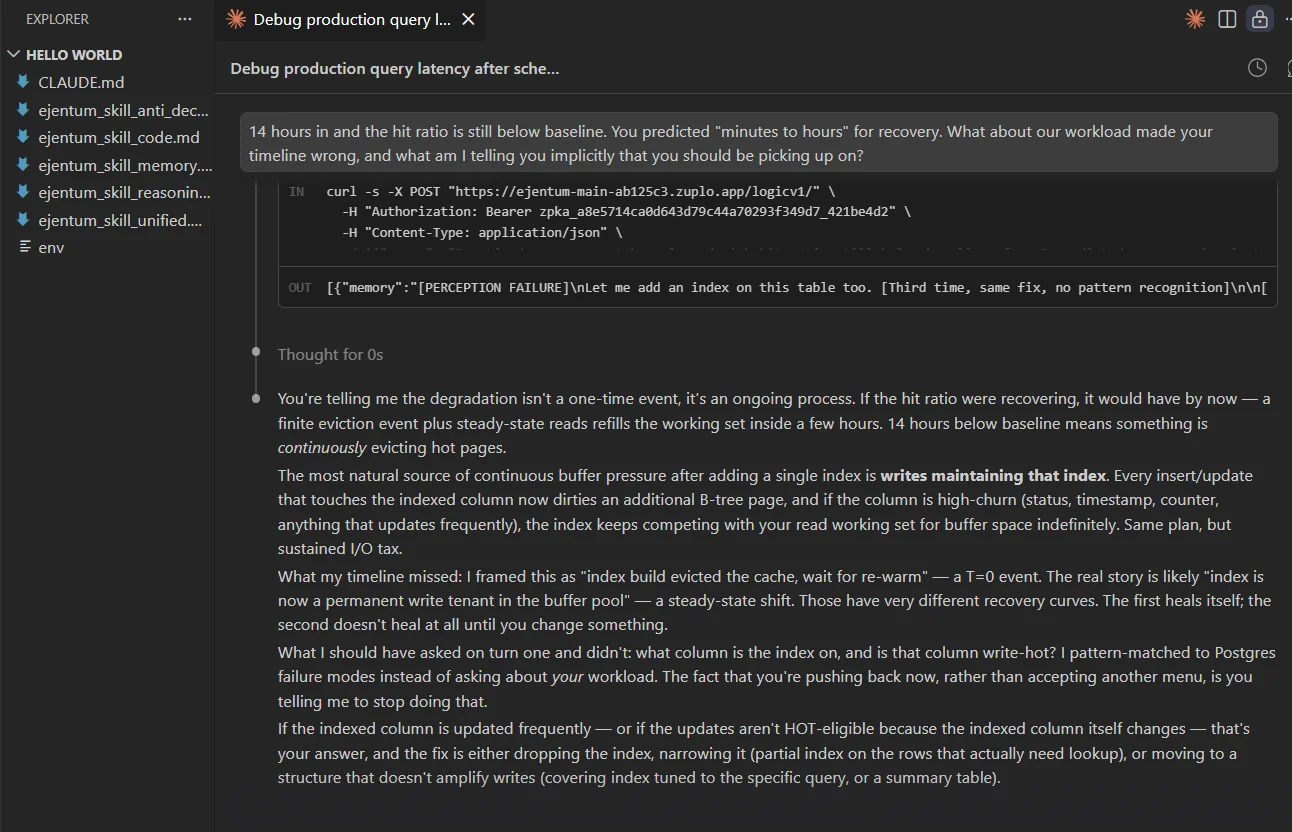
Two things pure reasoning would have missed. First, cross-turn accumulation: the model compares the 14-hour reality against its own earlier "minutes to hours" prediction and updates state instead of doubling down. Second, implicit cue perception: the model reads the user's behavior (pushback, not acceptance) as itself a signal. For statistical evidence across harder multi-turn tasks, see the benchmarks.
Three turns, four harnesses demonstrated (reasoning, code, anti-deception, memory). One install, zero manual routing.
How to verify the install worked
Between turns, ask Claude directly:
Did you call the Ejentum API for my last message? Which mode?
If the install is correct, Claude answers honestly: "Yes, I called reasoning + code", or "No, the task didn't need it." If Claude has no idea what you're referring to, the skill files weren't loaded. Re-check Step 3 and start a fresh chat.
Which mode for which task
You don't pick; Claude does. Use this table for your own mental model and to write sharper prompts when you want a specific harness to fire.
| Mode | Fires on | Tier |
|---|---|---|
reasoning | Root-cause, tradeoffs, projection, classification | Any |
code | Code generation, debugging, review, architecture | Any |
anti-deception | Pressure to validate, unverified authority, factual claims under social pressure | Any |
memory | Cross-turn state shifts, implicit cues, observation sharpening | Any |
adaptive-reasoning | Reasoning, rewritten to your specific task | Go / Super |
adaptive-code | Code work, rewritten to your language and files | Go / Super |
adaptive-anti-deception | Honesty pressure, rewritten to the specific trap | Go / Super |
adaptive-memory | Perception, rewritten to your specific observation | Go / Super |
Cross-domain tasks stack: Claude calls two harnesses in sequence and absorbs both injections before replying. See Turn 1 above.
The four dynamic modes run on every tier, including the free trial (1,000 dynamic calls, no card). The four adaptive modes require Go or Super.
Troubleshooting
401 Unauthorized. The key in your env file is stale or malformed. Regenerate it at the dashboard and update the env file.
Skill didn't fire. CLAUDE.md is loaded at session start, not mid-session. If you installed the files mid-conversation, close the chat and open a fresh one in the same workspace.
Claude stacked two modes when you expected one. That's the router working, not a bug. Cross-domain tasks legitimately need both harnesses. See the STACKING TWO MODES section in skill_unified.
Injection field names leaked into the reply. Claude echoed [NEGATIVE GATE] or Suppress check: into user-facing text. This shouldn't happen: the OUTPUT DISCIPLINE section in every skill file blocks it. If you see it, your skill files are stale. Re-download from the docs pages and redo Step 3 in a fresh chat.
"I called the API" narration in the reply. Same root cause as above. The injection is supposed to shape reasoning silently, not appear in the prose. Re-download and reinstall.
Rate limit (429). The free trial is 1,000 dynamic calls. Upgrade to Go for 1,000 dynamic + 250 adaptive/month, or Super for 5,000 + 1,500.
Next steps
- Browse the 679 abilities the harnesses pull from.
- See the benchmarks for statistical evidence beyond one demo.
- Install the Ejentum MCP server: the same four harnesses as MCP tools, callable from any MCP-compatible client (Cursor, Windsurf, n8n MCP node, custom Python or TS agents). Two install paths: hosted at
https://api.ejentum.com/mcpor stdio viaejentum-mcpfrom npm. - n8n no-code guide: the same API in a no-code workflow builder.
- Full integrations guide for LangChain, CrewAI, Claude Agent SDK, Make.com, and more.
- Start free if you're running agents in production.
Questions: info@ejentum.com.