Reasoning
Channels analytical power across six cognitive dimensions: causality, time, space, simulation, abstraction, and metacognition. It blocks the shortcuts that quietly flatten careful analysis into surface-level pattern matching.
A tool your agent calls mid-task. It returns the exact reasoning strategy for the problem in front of it.
Connect any MCP client →api.ejentum.com/mcpShip agents that stay reliable at their 100th step.
The Problem
Static reasoning baked at build time can't handle what agents encounter at runtime. Here's what breaks.
Your agent applies the same reasoning to a 3-step task and a 30-step chain. It cannot shift gears. The cognitive strategy is frozen at deploy time.
Three-agent chain at 90% step accuracy: 73% end-to-end success. Five agents: 59%. Reasoning errors don't add. They compound, each hop inheriting and amplifying what broke upstream.
Reasoning failures don't throw exceptions. By the time wrong output surfaces, the agent has already made three more decisions on top of the bad one. There's no stack trace for cognition.
Models lose mid-prompt content. The guardrail you need is the one the model stopped reading by token 2,000. Your 5,000-token system prompt competes with itself.
The agent commits to its first interpretation and never self-corrects. On ARC-AGI-3, this is the #1 failure mode of every frontier model. The hypothesis feels right, so the agent stops questioning it.
The agent reaches the first plausible answer and presents it as final. No verification, no alternatives considered, no uncertainty flagged. In our benchmarks, baseline agents self-monitored on less than 25% of tasks.
Your agent reasons well about causality but misses the temporal dependency. Or nails the spatial layout but ignores the simulation consequences. Real tasks span multiple dimensions. Single-lens reasoning misses the intersection.
These are architecture problems, not prompt problems. The fix is inference-time reasoning correction: a different cognitive ability retrieved for every task, selected at runtime.
How It Works
...and returns a cognitive operation matched to your task.
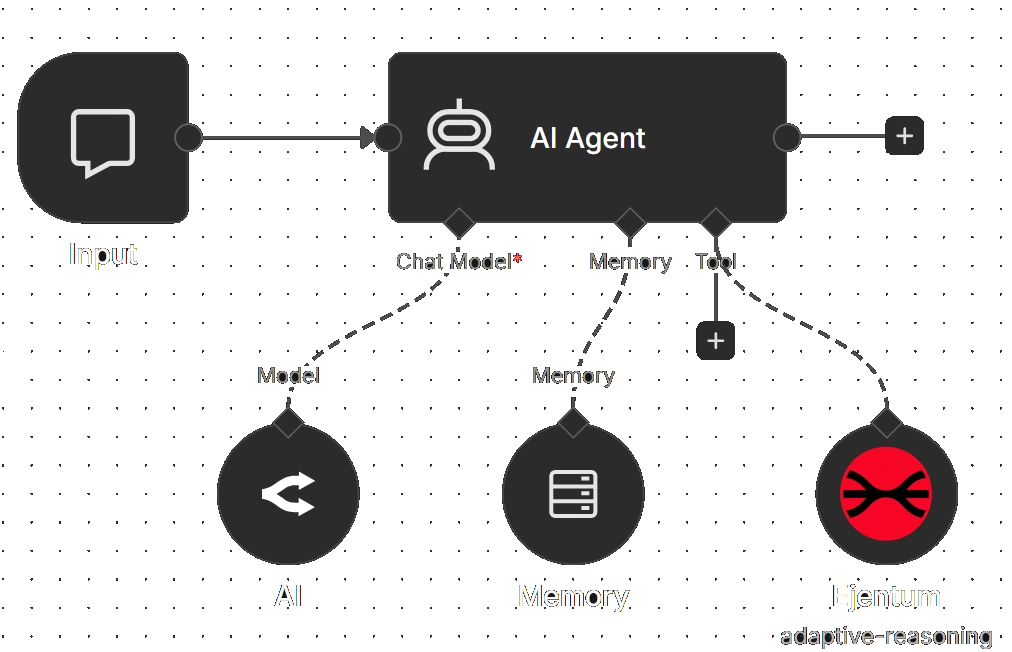
Dynamic reasoning when speed matters, adaptive when the task is novel. Four harnesses to keep your agent sharp: reasoning, code, anti-deception, memory. See one on the Quickstart.
Frameworks & IDEs
CrewAI, LangChain, LangGraph, LlamaIndex, Pydantic-AI, Agno, AutoGen, plus Cursor, Windsurf, Claude Code, Codex. Native packages or one skill file.
Integrations guide →Ejentum API
Your model already has the power. Ejentum harnesses it. Dynamic returns the best-fit ability as engineered; Adaptive rewrites it to fit your task. One call, one injection.
New here? The Quickstart has you calling a live harness in under a minute. Try it on your own agent.
Evidence
Same frontier model. Same tasks. Once without Ejentum, once with. Five benchmarks, four harnesses, one change.
The model already had all of this. Coding passes jumped to 100% when the spirals stopped. Scientific bugs fell to zero when the shortcuts got blocked. Reasoning depth multiplied twelvefold when the drift got caught. Sycophancy dropped to 5.8% when the flattery reflex got suppressed. Perception tripled when observation got enforced.
The harness doesn't add capability. It removes the failure that was consuming it.
Universal Integration
 LangGraph
 CrewAI
 Heym
Heym LlamaIndex
 Flowise
 Langflow
 Mastra
 Botpress
 Voiceflow
 AgentOps
 Smolagents
 Antigravity
 Codex
Codex Claude Code
 Groq
Groq Cohere
 xAI
xAI DeepSeek
 Inception Labs
 Fireworks AI
 Nous Research
Pricing
One month free. 1,000 dynamic calls. No card.
Super
dynamic + adaptive · all harnesses
Tailored reasoning. The harness rewrites the cognitive operation to fit your specific task. Safety checks stay locked.
Get Started →Go
dynamic + adaptive · all harnesses
Dynamic reasoning across all four harnesses. Adaptive included.
Free trial
one month · no card
See what the harness does to your agent before deciding.
Start free. Step up to Go for ongoing use. Super when your agent needs adaptive reasoning at production volume.
Honest Scope
Ejentum doesn't help every agent. If you're running a single-step classifier, a simple RAG lookup, or any task where the model already converges in one hop, you're paying for cognitive overhead you don't need. Ejentum earns its cost on multi-step chains where errors compound: planning agents, research agents, code agents that touch more than a handful of files. If that's not you, don't buy this yet.
Frank Brsrk
Founder
One month free. 1,000 dynamic calls. No card.